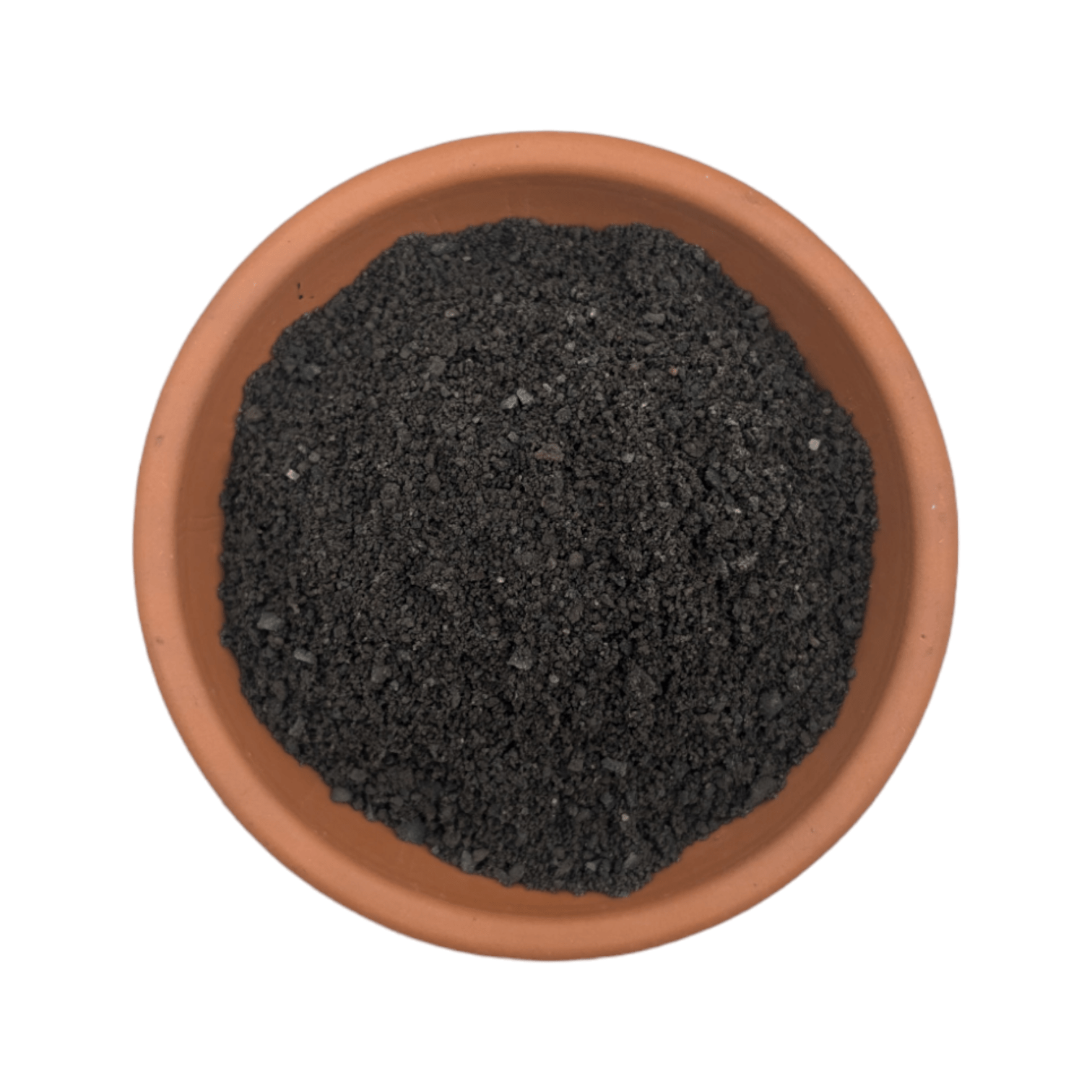
What exactly is Volcanic Rock Dust?
A finely crushed volcanic mineral blend that re-mineralises soil with a broad spectrum of trace elements and silica. It feeds soil microbes, helps build stronger cell walls, and supports long-term plant resilience. It’s not a quick N-P-K fertiliser—think of it as the “multivitamin” for your soil.
What’s in Volcanic Rock Dust?
Naturally occurring volcanic minerals (basaltic origin) ground to a typical particle size of ~0.2–3 mm. That spectrum delivers calcium, magnesium, iron, potassium, silica and dozens of trace elements your compost and fertilisers can miss.
How much should I use?
General garden rate: 50–150 g per m² (use the higher end for depleted or compacted soils). That’s the same as 5–15 kg per 100 m².
How far does a bag go?
At 50–150 g/m²:
• 1 kg covers ~6–20 m²
• 2.5 kg covers ~17–50 m²
• 10 kg covers ~67–200 m²
• 20 kg covers ~133–400 m²
How do I apply Volcanic Rock Dust?
Sprinkle evenly and rake or fork into the top 5–10 cm of soil, or top-dress and water in. For pots and raised beds, blend through the mix before planting or lightly top-dress and scratch in.
How often should I reapply?
For most gardens, once at bed prep and then a light top-up every 6–12 months. Heavy-feeding beds or very sandy soils may benefit from a light dust each season.
Will Volcanic Rock Dust burn plants if I overdo it?
No—rock dust isn’t “hot” like synthetic fertilisers. Over-application is mostly a waste of product and can very slightly nudge pH upward in acidic soils. Stick to the guide rates.
Does Volcanic Rock Dust change soil pH?
Slightly. Basaltic volcanic dusts tend to be mildly liming in very acidic soils. In neutral or slightly alkaline soils you won’t see meaningful pH movement at normal rates.
Is Volcanic Rock Dust safe for vegetables, kids, and pets?
Yes—used as directed it’s garden-safe. It’s a mineral powder, so avoid breathing dust: wear a mask on windy days and water it in after spreading.
Can I use Volcanic Rock Dust on lawns?
Absolutely. Apply 50–100 g/m² once or twice a year. For best results, spread before rain or irrigate after application.
Good for fruit trees?
Yes. Work 100–200 g per m² into the dripline area during spring or autumn and mulch over the top.
What about seedlings and seed-raising mix?
Go light: mix ~5–10 g per litre of potting mix, or a teaspoon per 1–2 L. For delicate starts, top-dress sparingly and water in.
Can I add Volcanic Rock Dust to compost or worm farms?
Do it. A handful per 10–20 L of compost speeds microbial action and helps lock nutrients. In worm farms, add a light sprinkle monthly to supply grit and minerals.
Will Volcanic Rock Dust replace fertiliser?
No. Rock dust supplies trace elements and silica; it’s not a full N-P-K feed. Pair it with quality compost, manures, or DRGT dry amendments for balanced nutrition.
Does Volcanic Rock Dust help with pests and disease?
Indirectly. Better mineral balance and added silica can thicken cell walls and support stronger plants that are naturally more tolerant of stress. It’s not a pesticide.
Is Volcanic Rock Dust compatible with mycorrhizae and soil microbes?
Yes—microbes help dissolve and deliver the minerals, so the two work hand-in-glove. It’s a great partner to inoculants like mycorrhizae.
Can I use Volcanic Rock Dust in hydroponics?
No. Rock dust isn’t soluble enough for hydro systems and will just settle out. Use it to mineralise soil, coco, or living mixes—not nutrient tanks.
How soon will I see results?
Temper your expectations. You may notice stronger colour and sturdier growth within a few weeks, but the real benefits are cumulative over months as biology unlocks minerals.
What does “typical particle size 0.2–3 mm” mean for me?
You’re getting a mix of fines (quick release) and small granules (longer release). If you want faster action in a bed, crush any larger granules between gloved fingers as you go.
Is finer always better?
Finer dust releases faster but can blow away. Our blend balances handling and longevity. If it’s windy, water lightly before and after spreading to keep it put.
Does Volcanic Rock Dust contain heavy metals?
All rocks contain trace amounts of various elements. Ours is sourced for garden use and applied at low rates. If you’re concerned, combine with ample organic matter—humus binds metals and moderates availability.
Can I mix Volcanic Rock Dust with other DRGT products?
Yep. It pairs perfectly with TurboDirt, Root Roids™/Fruit Roids™, and our dry amendments. Add rock dust at bed prep, then feed with your usual program.
Best time of year to apply?
Anytime you’re prepping beds or top-dressing. Spring and autumn are ideal. On hot, dry days, water in well.
Should I water after application?
Yes—either time it before rain or irrigate to settle the dust and start the mineral-microbe handshake.
Can I top-dress mulch with Volcanic Rock Dust, or does it have to be in the soil?
Both work. If you spread it over mulch, hose it down so it filters through; even better, peel mulch back, dust the soil, then replace the mulch.
Will Volcanic Rock Dust help with sandy soils that leach nutrients?
Over time, yes. The added minerals and improved microbial activity help build structure and reduce leaching—especially when combined with compost and regular mulching.
What about heavy clay?
It won’t “fix” clay on its own, but alongside organic matter it can improve structure and drainage as biology increases.
Can I use Volcanic Rock Dust around natives or acid lovers (azaleas, blueberries)?
Use the lower end of the rate (50 g/m²) and monitor pH. For strict acid lovers, keep applications light and pair with acid-friendly mulches.
Does Volcanic Rock Dust stain paths or concrete?
It can leave a dusty film. Sweep or hose hard surfaces immediately after spreading.
How should I store Volcanic Rock Dust?
Dry and sealed. Rock dust attracts moisture and will clump if left open. If it clumps, just crumble and use.
What’s the volume of 1 kg?
Roughly 600 mL. Handy when you’re measuring by scoop rather than weight.
Why not just use Azomite or glacial rock dust instead?
Different rocks, different mineral profiles. Basaltic volcanic dust is an excellent, locally relevant option with a broad spectrum of beneficial minerals. For Australian gardens, it’s a smart, low-fuss way to remineralise without overcomplicating things.
Any situations where I shouldn’t use Volcanic Rock Dust?
Skip it in recirculating hydro, don’t blow it around indoors, and don’t expect it to rescue plants that are starving for N-P-K. It shines as part of a living-soil system, not as a silver bullet.
Quick recipe for raised beds (forward-thinking mix):
Per 50 L of mix add 100–150 g rock dust, 10–20 % mature compost, and biochar at 5–10 % pre-charged with compost tea or liquid feed. That sets you up for seasons, not weeks.