Use this bar to show information about your cookie policy.
Roll over image to zoom inClick on image to zoom
/
Description
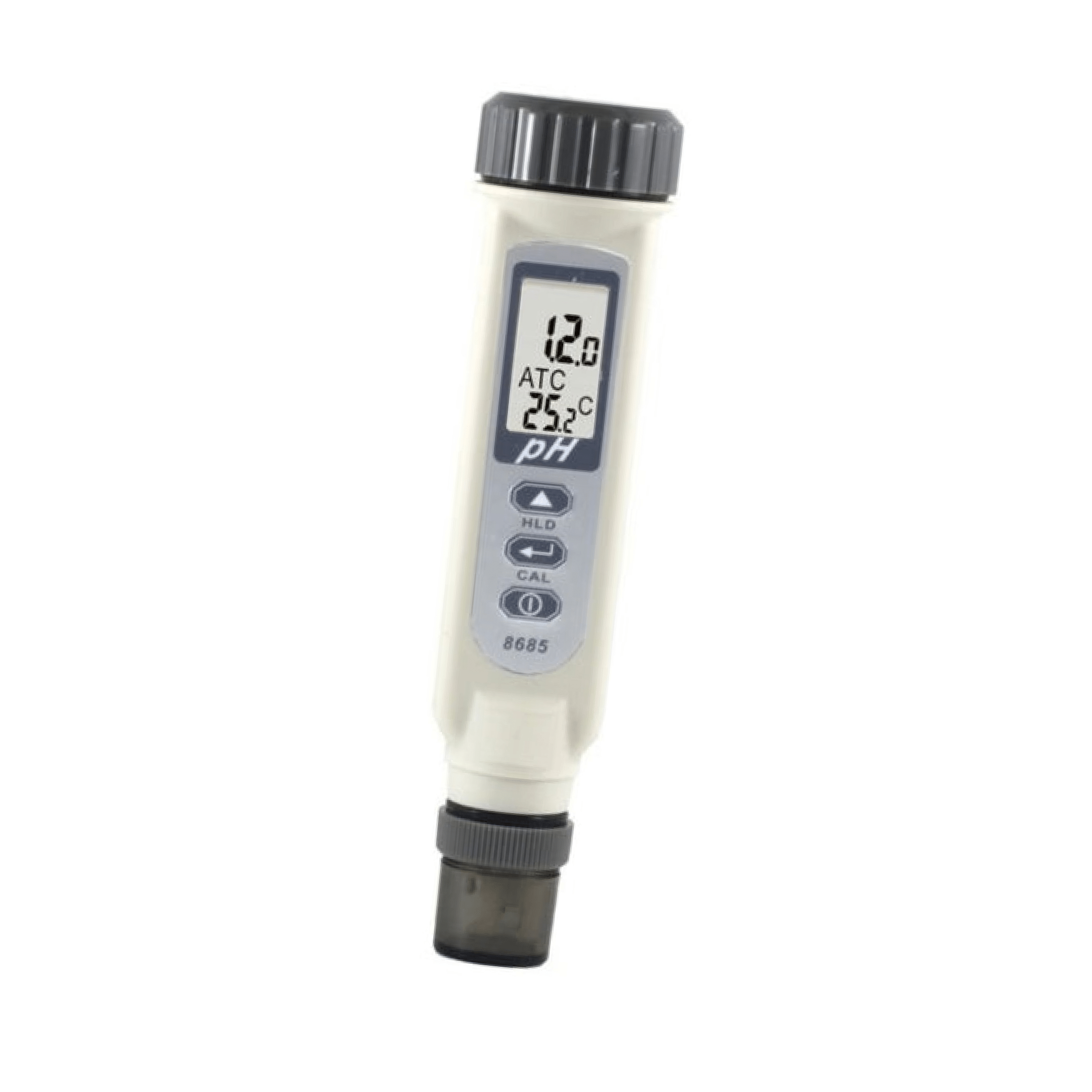
The AZ Waterproof pH Meter Pen with Automatic Temperature Compensation (ATC) is a precision instrument designed for accurate measurement of pH levels and temperature in various solutions.
Its robust, waterproof construction and user-friendly features make it ideal for applications in hydroponics, aquaculture, water treatment, swimming pools, and laboratory environments.
Key Features:
Wide pH Measuring Range: Measures pH levels from 0.0 to 14.0, accommodating a broad spectrum of testing needs.
Dual Display with ATC: Large IP65-rated LCD screen simultaneously displays pH and temperature readings, with Automatic Temperature Compensation ensuring accuracy across varying conditions.
Waterproof Design: IP65-rated housing provides durability and reliability in wet environments.
One-Touch Auto Calibration: Simplifies the calibration process with automatic buffer recognition to prevent errors.
Hold Function: Allows users to freeze the current reading for easy viewing in low-visibility conditions.
Auto Power Off: Conserves battery life by automatically turning off after periods of inactivity.
Compact and Portable: Pen-sized design fits comfortably in your pocket or toolkit for on-the-go testing.
Why You’ll Love It:
Ensuring accurate pH measurements is crucial for the health and efficiency of various systems, from hydroponic setups to swimming pools. The AZ Waterproof pH Meter Pen offers a combination of precision, durability, and ease of use, making it an essential tool for both professionals and enthusiasts. Its waterproof design and automatic temperature compensation provide reliable performance in diverse environments.
FAQs:
Q. How often should I calibrate my pH meter?
The frequency of calibration depends on your specific application. Here is a recommended approach to determine the appropriate calibration interval:
a.Calibrate the pH meter on the first day.
b.On subsequent days, immerse the electrode in the original calibration buffers and record the readings.
c.If the readings remain within acceptable limits, continue this daily check until the accuracy no longer meets your requirements.
When the readings become unsatisfactory, recalibrate and note the number of days since the initial calibration. For example, if accuracy declines after five days, calibrate every four to five days thereafter. As the pH electrode ages, repeat this test monthly to reassess the calibration interval.
Q. What is the lifespan of a pH probe? The lifespan of a pH probe varies depending on factors such as storage conditions, maintenance practices (refer to the user manual), the pH value of the sample, temperature, pressure, and sample type. Probes used with contaminated samples (e.g., solutions containing particles), subjected to mechanical abrasion, or exposed to high temperatures or pressures may last only a few weeks. In hot alkaline solutions, probes can become damaged within hours. Elevated temperatures also shorten electrode lifespan; for every 25°C increase above 25°C (e.g., testing at 50°C), the lifespan of a general-purpose pH electrode is approximately halved. For optimal longevity, testing at around 25°C is recommended.
Q. Why is my pH probe responding slowly or showing drifting readings?
Slow response or drifting readings may result from:
a.Contamination of the glass bulb: Deposits such as oil, grease, paint, or dirt can impair performance.
·Solution: Rinse the probe with distilled water or refer to the maintenance section of the user manual for cleaning instructions.
b.End of probe lifespan: The probe may be nearing the end of its functional life.
·Solution: Contact the supplier from whom you purchased the pH meter to obtain a replacement probe or meter.
Q. Why can’t I calibrate my pH probe?
Calibration issues may arise due to:
a.Dried-out electrode: If the probe has been stored without sufficient storage solution, it may dry out.
·Solution: For A-Z pH electrodes, regularly replenish the storage solution to keep the electrode hydrated. A suitable storage solution maintains constant ion activity in the sensing element, ensuring fast response and accurate readings. Temporarily, tap water can be used as a storage solution, or any commercially available pH probe storage solution is acceptable. Distilled water is suitable for cleaning but unsuitable for storage.
b.If the electrode has dried out, try the following steps to restore it: o Immerse the electrode in warm water (approximately 60°C) for 15 minutes to dissolve any dried impurities.
·Transfer the electrode to a solution containing 4M KCl (4 moles of potassium chloride per litre of solution), initially at 60°C and allow it to cool to room temperature.
c.End of probe lifespan: The probe may be at the end of its functional life.
·Solution: Contact the supplier to purchase a replacement pH probe or meter.
Q. How should I store my pH electrode? To maintain the condition of the glass sensing element, pH electrodes must be kept hydrated. Allowing the sensing element to dry out will damage the electrode. A proper storage solution ensures consistent ion activity in the sensing element, promoting rapid response and accurate readings. The recommended storage solution for A-Z electrodes is a 1:1 mixture of 4M KCl and pH 4 buffer. If this is unavailable, tap water can be used temporarily, or any commercially available pH probe storage solution is suitable. Important: Never store a pH electrode in distilled water. While distilled water is ideal for rinsing between samples, it is harmful for storage as it depletes the electrolyte in the reference chamber, damaging the electrode.
Q. Is this pH meter suitable for hydroponic systems? Yes, it is ideal for monitoring nutrient solutions in hydroponic systems to ensure optimal plant growth.
Q. Can it be used for testing swimming pool water? Absolutely. This meter can accurately measure the pH levels of pool water, helping maintain proper chemical balance.
Q. How often does the device need calibration? Regular calibration is recommended to maintain accuracy, especially with frequent use. The one-touch auto-calibration feature makes this process straightforward.
Q. What is the temperature range it can measure? The meter measures temperatures ranging from -5°C to +60°C, accommodating various testing conditions.
Q. Is the device battery-operated? Yes, it operates on four LR44 batteries, which are included in the package.
Secure & Encrypted Payments
Estimate shipping
Frequently Asked Questions (FAQ)
What does the AZ Waterproof pH Meter Pen with ATC measure?
It measures pH and temperature in liquids, displaying both values at once. It supports a wide pH range (0.0 to 14.0) and temperatures from -5°C to +60°C, with the ability to switch between Celsius and Fahrenheit.
What is ATC and why does it matter?
ATC stands for Automatic Temperature Compensation. It adjusts pH readings to account for solution temperature, which helps ensure more accurate results in real-world conditions where temperature can vary.
Where can I use the AZ Waterproof pH Meter Pen with ATC?
It’s ideal for hydroponics, aquariums, ponds, pools, labs, and general water testing. It's designed for testing liquids only—not for inserting directly into soil or coco coir.
Is the AZ Waterproof pH Meter Pen waterproof?
Yes—it has an IP65-rated housing, which protects against dust and water splashes. It’s perfect for wet grow rooms, but not designed for full submersion.
How do I calibrate the AZ Waterproof pH Meter Pen?
It uses one-touch auto calibration with automatic buffer recognition. For hydroponics, use pH 7.0 and pH 4.0 solutions. Regular calibration (weekly or as needed) ensures continued accuracy.
How do I clean and maintain the pH probe?
Rinse gently after each use. If readings drift or slow down, clean the sensor with a proper pH probe cleaner, rinse again, and recalibrate. Avoid testing concentrates or scrubbing the sensor.
How should I store the AZ Waterproof pH Meter Pen between uses?
Store the probe tip in a proper KCl-based pH storage solution to prevent drying. Never store it in distilled water, which can damage the probe. Good storage habits extend probe life.
Why is my pH meter reading inaccurately?
Check for probe dryness, contamination, expired buffers, or low battery. Rehydrate if needed, recalibrate, and clean the probe before assuming it's faulty. Stable readings require basic care.
Can the AZ pH Meter help prevent nutrient lockout?
Yes—keeping your pH in the correct range helps prevent nutrient lockout. While it can’t fix lockout directly, consistent pH control is one of the best ways to avoid it entirely.
How do I get the most accurate pH reading?
Use a clean, well-mixed sample, avoid air bubbles, and let the reading stabilize. Rinse between tests and keep the probe hydrated. Always allow time for mixing after dosing pH adjusters.
Can I test directly in the reservoir or should I use a sample cup?
Either works, but sample cups reduce contamination and are better when testing multiple systems. Inside reservoirs, test in well-circulated zones and avoid areas with direct aeration or fresh dosing.
Can air bubbles affect readings?
Yes—bubbles can cause unstable or jumpy readings. Gently swirl the probe to release trapped bubbles for more consistent results.
What kind of batteries does it use?
The meter uses four LR44 button cell batteries. It includes auto shut-off to save power and a low battery indicator to help avoid inaccurate readings from low power.
Does the meter have a hold function?
Yes—there’s a Hold button that freezes the current reading on-screen, which is useful when testing at awkward angles or in low light.
Is the AZ Waterproof pH Meter Pen beginner-friendly?
Yes—its one-button calibration, dual display, and rugged build make it great for beginners. Just follow basic maintenance: rinse, calibrate, and store the probe correctly.
Lovely high-grade compost plants and roots thrive in this mixed with coca coia .Added to top of pot 2cm layer after several weeks of growth and within 3days roots smothered the surface and have fill that new layer. I am sure pleased with this compost highly recommend this product. Regards M.
Thanks Mark! Love hearing the Fish & Kelp Compost has your roots absolutely going for it! 🌱 Seeing them fill that fresh layer within days is cracking stuff. Really appreciate the recommendation mate, happy growing! 🙌
These bags are not only cheaper than plastic or terracotta pots, they are an environmentally sound option. In my case the plants will sit in a garden to create a lush landscape, and the pots will be amongst the foliage, but they are attractive as well and could be on display.
Great idea, handles also make them easier to manage. I also loved the humour of Dr Greenthumb! Keep it up, we all need a laugh 😆
Thanks Catherine! Love hearing the bags are ticking all the boxes with value, looks and easy handling! 🌱 Stoked you’re enjoying our sense of humour too 😆 We’ll definitely keep the laughs coming. Really appreciate the cracking feedback! 🙌
Thanks people I’ll be back in future for all things that are hard to get other places .
Really appreciated the quick replies too .
Thanks legend! Stoked the pumice quality, speedy service and quick replies all hit the mark! 🌵 Really appreciate the support, and we’ll be happy to have you back for those hard-to-find goodies! 🙌