

Use this bar to show information about your cookie policy.
Roll over image to zoom inClick on image to zoom
/
Description
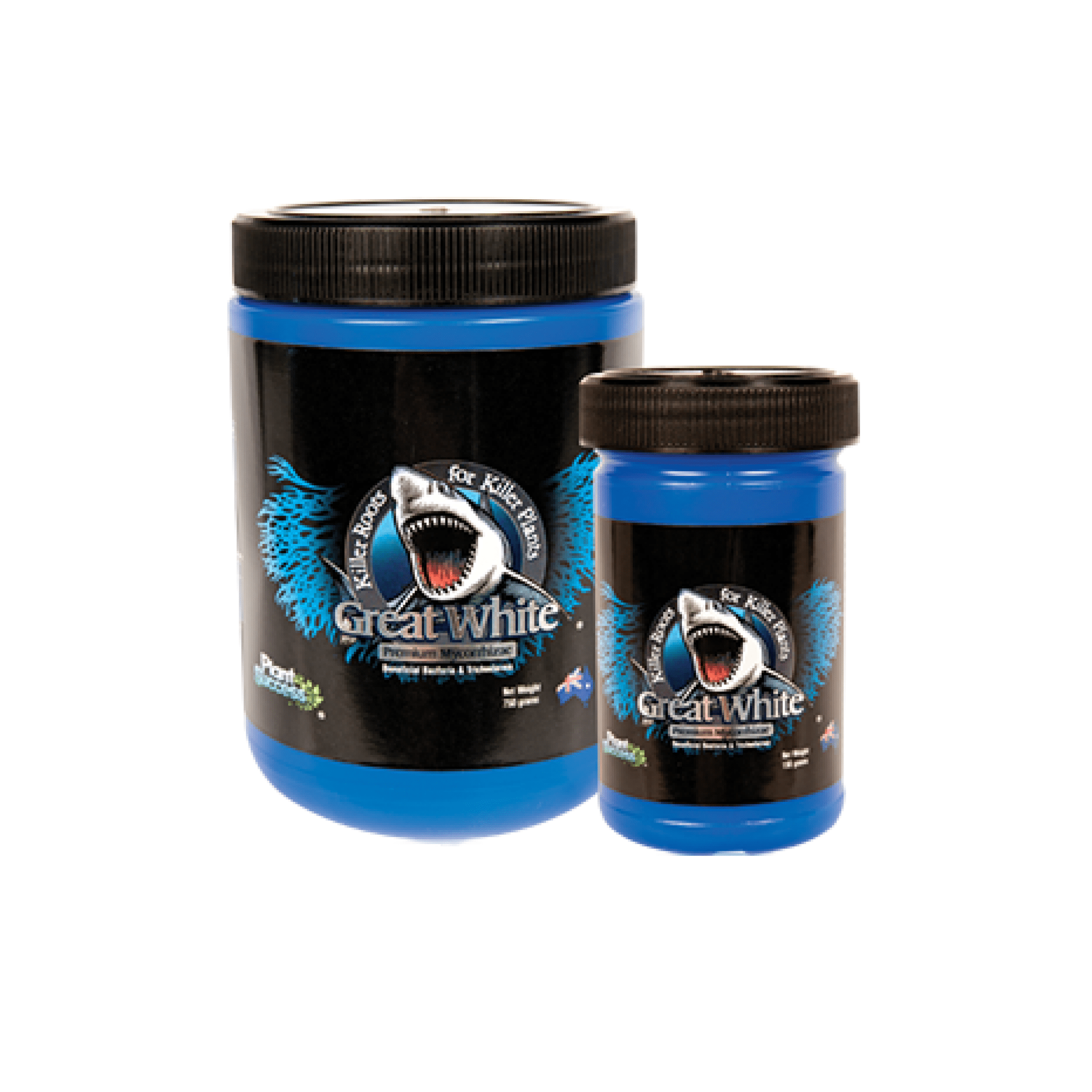
Great White is the market’s most cutting-edge premium mycorrhizae formula. This highly concentrated and diverse blend of beneficial microbes will help boost your plants’ root systems, leading to greater water retention and nutrient uptake.
Mycorrhizae form a type of symbiotic relationship between fungi and plant roots. The fungi colonize the roots and form a network of filaments called mycelium. In exchange for sugars produced by the plant, the mycorrhizae help to increase the surface area of the roots, improve water and nutrient uptake, and protect the roots from pathogens.
For gardeners, this symbiotic relationship can be beneficial in several ways. First, it can help to improve the health of plants by providing them with additional nutrients and water. Second, it can help to reduce the need for chemical fertilizers and pesticides. Finally, it can help to improve soil structure and increase the population of beneficial microorganisms. Consequently, mycorrhizae play an important role in sustainable gardening practices.
Great White can be used in all stages and all growing types. Use weekly for best results.
Seeds:Lightly dust with Great White.
Cuttings:Dip cutting into rooting gel/solution then lightly dip directly into Great White powder. Mix into pre-soak/fertilizer solution at a rate of 1 tsp or 3.3 grams per 2 gallons 7.5 litres of water.
Transplanting:Lightly dust planting hole and place plant directly on top.
Soil, Coco and Topfeeding:Apply at a rate of 1 tsp (3.3 grams per 2 gallons (9 litres) of water.
Hydroponics:Mix into reservoir with regular feeding at a rate of 1 tsp (3.3 grams) per 10 gallons (38 litres) of water.*
*Hydroponic users may find settling or particles on bottom of reservoir and should not be concerned of product loss; it’s normal for the carrying agent to settle.
Ingredients
Endomycorrhiza Glomus aggregatum – 83 props per gram Glomus intraradices – 83 props per gram Glomus mosseae – 83 props per gram Glomus etunicatum – 83 props per gram Glomus clarum – 11 props per gram Glomus monosporum – 11 props per gram Paraglomus brazilianum – 11 props per gram Glomus deserticola – 11 props per gram Gigaspora margarita – 11 props per gram
Ectomycorrhiza Pisolithus tinctorious – 187,875 propagules per gram Rhizopogon luteolus – 5,219 props per gram Rhizopogon fulvigleba – 5,219 props per gram Rhizopogon villosullus – 5,219 props per gram Rhizopogon amylopogon – 5,219 props per gram Scleroderma citrinum – 5,219 props per gram Scleroderma cepa – 5,219 props per gram
Bacteria Azotobacter chroococcum – 525,000 CFU’s per gram Bacillus subtilis – 525,000 CFU’s per gram Bacillus licheniformis – 525,000 CFU’s per gram Bacillus azotoformans – 525,000 CFU’s per gram Bacillus megaterium – 525,000 CFU’s per gram Bacillus coagulans – 525,000 CFU’s per gram Bacillus pumilus – 525,000 CFU’s per gram Bacillus amyloliquefaciens – 525,000 CFU’s per gram Paenibacillus durum – 525,000 CFU’s per gram Paenibacillus polymyxa – 525,000 CFU’s per gram Pseudomonas aureofaciens – 525,000 CFU’s per gram Pseudomonas fluorescens – 525,000 CFU’s per gram
Contains the following 3 species Trichoderma koningii-187,875 CFU’s per gram Trichoderma harzianum-125,250 CFU’s per gram Saccharomyces cerevisiae – 525,000 CFU’s per gram
Secure & Encrypted Payments
Estimate shipping
Frequently Asked Questions (FAQ)
What is Great White Mycorrhizae and what does it do?
Great White is a concentrated microbial inoculant that combines mycorrhizal fungi, beneficial bacteria, and Trichoderma. It helps roots form a larger underground network to improve water and nutrient uptake, root mass, and plant resilience. The blend includes 16 mycorrhizal fungi, 14 bacterial species, and 2 Trichoderma strains to support vigorous growth across a wide range of plants.
Is Great White Mycorrhizae a fertiliser, and is it organic?
No—Great White isn’t a fertiliser in the NPK sense. It’s a microbial product that helps plants access existing nutrients more effectively. It’s widely used in organic-style gardens and aligns with biological growing practices, but always check certification rules if compliance matters to you.
What plants can benefit from Great White Mycorrhizae?
Most vegetables, herbs, flowers, fruiting plants, trees, and houseplants respond well—especially during transplanting or active growth. Brassicas (e.g., broccoli, cabbage) may see limited results due to weak mycorrhizal associations.
When is the best time to apply Great White?
Transplanting is the ideal moment—getting microbes in contact with young roots early gives the best colonisation. Many growers also reapply during early veg, after root disturbance, or when reinforcing the root zone. Results typically show within 1–3 weeks.
Can I use Great White in soil, coco, or hydroponics?
Yes—it works in all common growing media. It’s especially effective in soil and coco. In hydroponics, expect some settling in the reservoir and avoid sterile systems, which aren’t friendly to microbes. Clean lines regularly to avoid clogging.
How do I apply Great White to seeds, cuttings, and transplants?
Dust seeds, lightly dip cuttings after rooting gel, or dust the transplant hole and root zone. You can also soak propagation cubes or mix it into potting media. For existing plants, topdress and water in. Weekly use during active growth is common.
Can I use Great White in compost tea or with other biologicals?
Yes—Great White pairs well with compost teas and organic inputs like worm castings or kelp. It also works alongside most microbial and fertiliser programs, though overstacking multiple inoculants can be redundant.
Does Great White help with transplant shock or drought tolerance?
Yes—mycorrhizae are especially helpful during transplanting and for improving water access in dry spells. It can also support better nutrient cycling, which may reduce the risk of lockouts, especially when growing conditions are managed well.
Can water quality or pH affect Great White performance?
Yes—heavily chlorinated water, strong pH adjusters, peroxide, or fungicides can reduce microbial viability. Always add Great White after adjusting pH, use filtered water where possible, and avoid combining with sterilising agents unless you plan to re-inoculate.
How should I store Great White, and does it expire?
Store it cool, dry, and sealed. Avoid moisture and direct sun—humidity is the main cause of clumping and microbe loss. While it doesn’t “go off” overnight, potency drops over time if stored poorly. Always use clean, dry tools when scooping.
Excellent service and quality products, good as gold!
Thanks Shane! Good as gold, we’ll take that! 😄 Stoked you’re happy with the service and quality mate. Really appreciate the cracking feedback and support! 🌱🙌
I immediately tested my courtyard pots with my new soil moisture meter. The results were very interesting, such variation. I feel this simple tool will be extremely useful this coming hot summer.
Thanks Pippa! Stoked the moisture meter is already showing its worth! 🌱 It’s amazing how much moisture can vary from pot to pot. Sounds like it’ll be an absolute winner when those hot summer days roll around! ☀️🙌
The reservoir was easy to set up and doing well for the intended purpose.
Thanks James! Great to hear the Hydro Tank was a breeze to set up and is working a treat! 💧 Cheers for the feedback mate, really appreciate the support! 🙌
To the greenthumbs only took a week for delivery of goodies happy customer will definitely order more goodies in the futre cheers .
Thanks Paul! Stoked your goodies arrived quickly and you’re a happy customer! 🌱 Really appreciate the support mate, and we’ll be happy to see you back for more goodies! 🙌
Appreciated how easy it was to use the product, as well as having questions answered about products on phone :)
Thanks legend! Stoked you found Root Roids easy to use and got the help you needed over the phone too! 🌱 Really appreciate the lovely feedback and support! 🙌