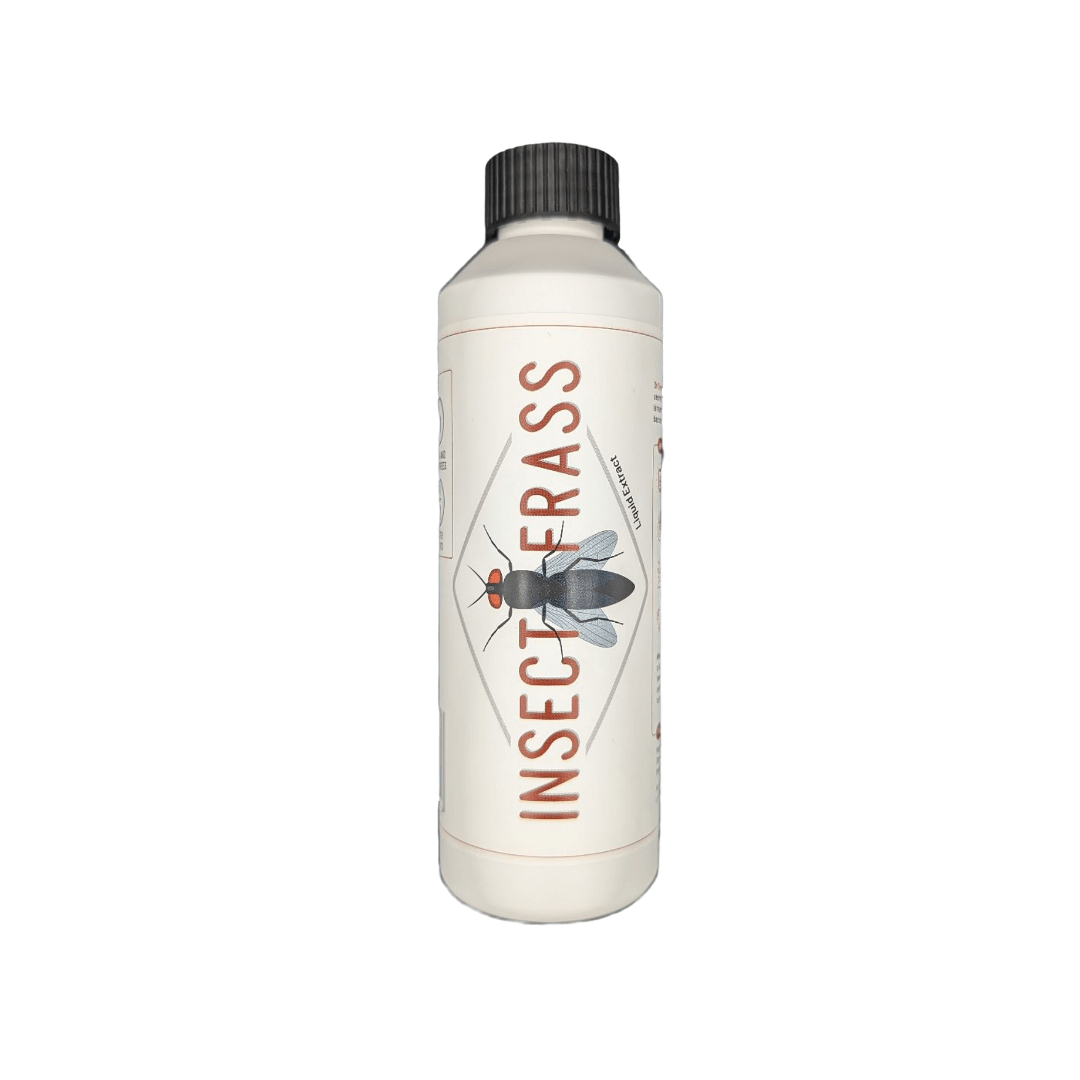
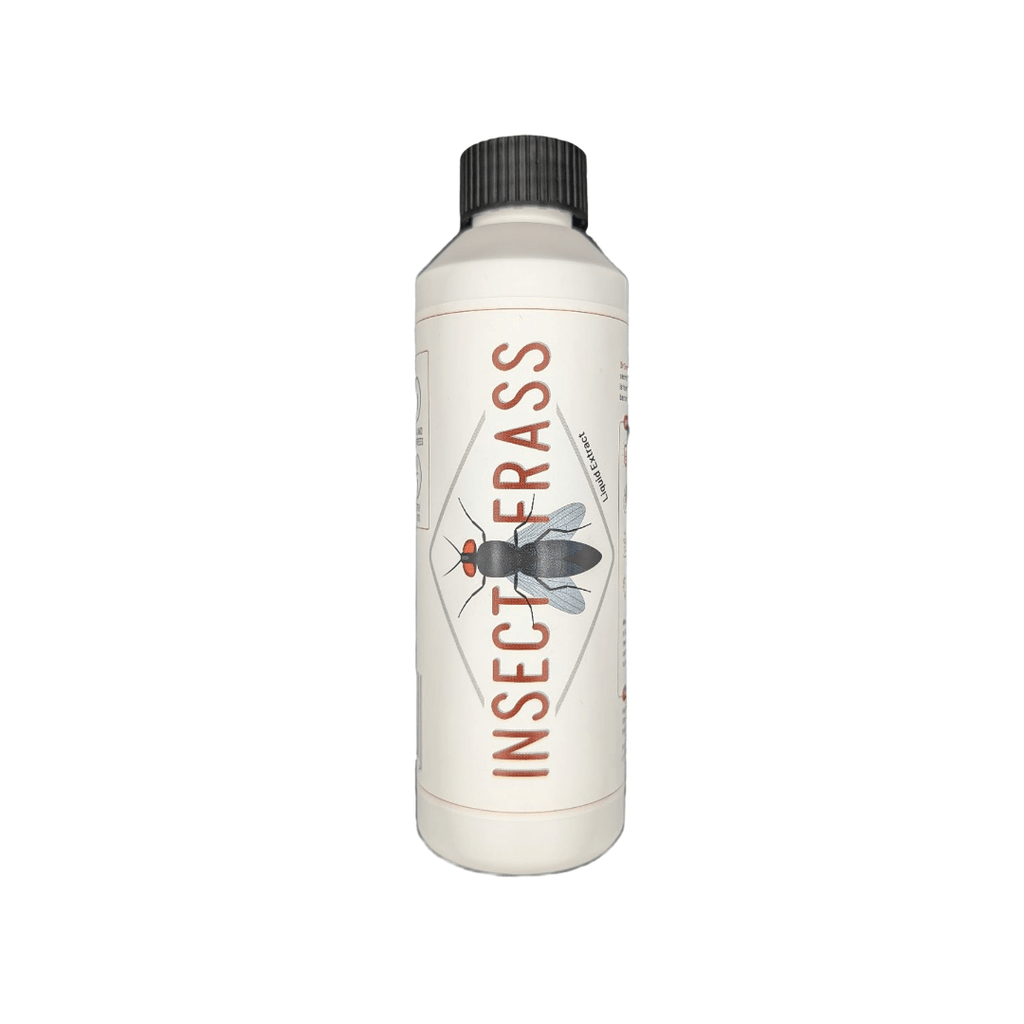
What exactly is this Liquid Insect Frass?
It’s a water-based extract made from insect frass (mainly black soldier fly larvae castings) that’s loaded with beneficial microbes and chitin-rich compounds. In short: biology in a bottle designed to wake up your soil and toughen up plants.
What does Liquid Insect Frass do for my plants?
Supercharges nutrient cycling, helps roots colonise with good microbes, and “primes” natural pest and disease resistance thanks to chitin. Expect stronger growth, better resilience, and improved overall health.
How do I mix Liquid Insect Frass?
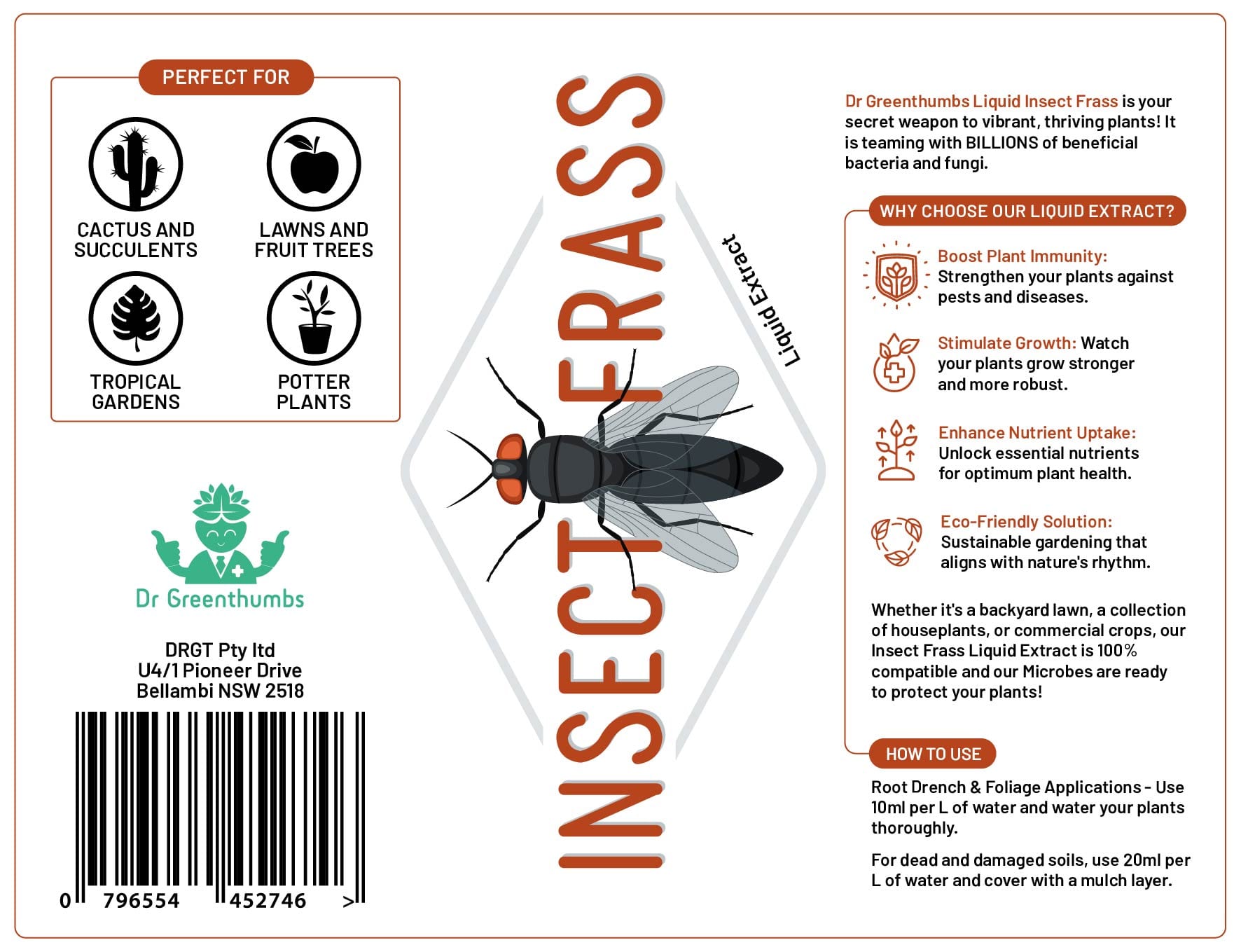
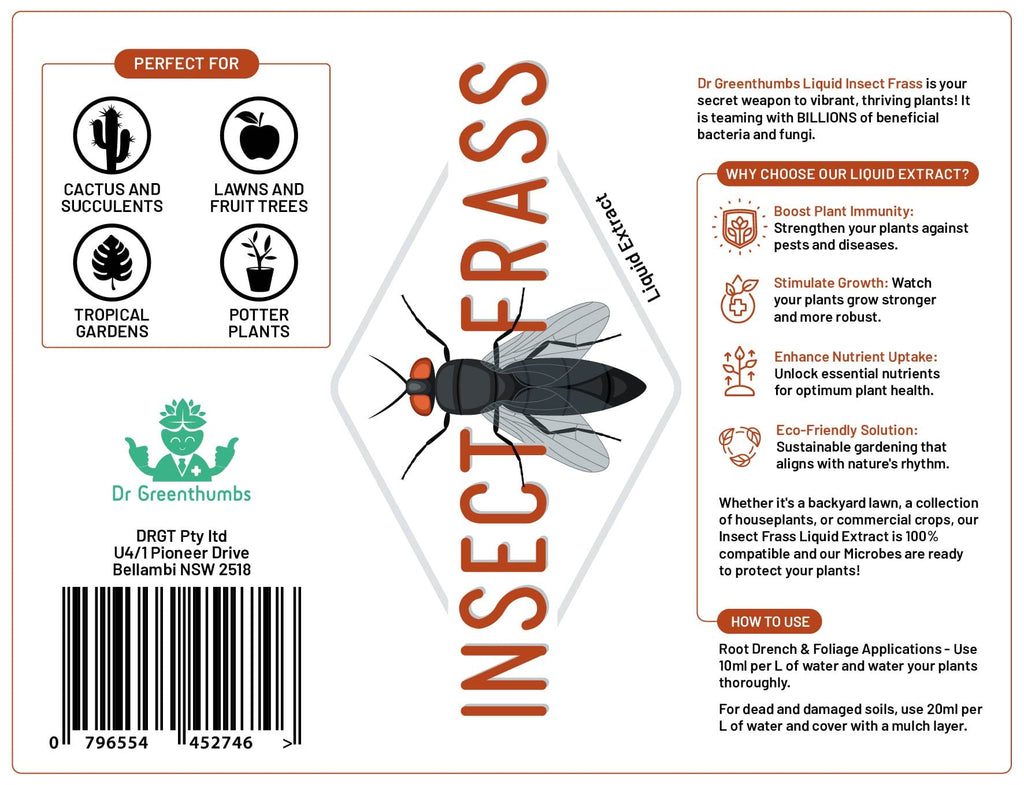
For regular use: 10 ml per 1 L of water. For tired/beat-up soils: 20 ml per 1 L of water. Give a light mulch after heavy applications to protect the biology.
Foliar or root drench—what’s best?
Both work. Root drench for soil biology and root health. Foliar is handy for a quick pick-me-up. If you’re spraying, make sure your water is dechlorinated and your sprayer is clean.
How often should I use Liquid Insect Frass?
As a maintenance tonic: every 1–2 weeks. For recovery or push periods (transplant, stress, early bloom): weekly for 2–3 weeks, then back to maintenance.
Can I use Liquid Insect Frass on all plants?
Yep—lawns, houseplants, veggies, ornamentals, natives, fruit trees, and container crops. It plays nicely with soil and coco. For delicate seedlings, start at half strength.
Is Liquid Insect Frass safe for edible crops?
Absolutely. It’s based on natural frass biology and is fine for herbs, veggies, and fruit. Rinse produce as you normally would.
Will Liquid Insect Frass burn my plants?
No. It’s a biological extract, not a hot salt fertilizer. Just stick to the rates above.
What about hydroponics/DWC/recirculating systems?
It can be used, but be sensible: dose lightly, use non-chlorinated water, and watch for biofilm in lines and filters. Many growers prefer using it as a foliar spray or as a pre-plant/soilless-media drench to avoid gunking up recirculating systems.
Does Liquid Insect Frass clog sprayers or drip lines?
It’s a liquid extract and generally fine, but always clean equipment and use a filter/strainer in sprayers. If you see any particulates, pre-strain before foliar.
Can I combine Liquid Insect Frass with my usual nutrients and additives?
Yes—pairs great with kelp, humics/fulvics, silica, calcium inputs, and most organic feeds. Avoid mixing in the same tank with oxidisers (hydrogen peroxide), strong acids/bases, or sterilising agents—they’ll kill the microbes you’re paying for.
Chlorinated tap water—do I need to worry?
A little chlorine can knock back microbes. If possible, let tap water stand 24 hours, bubble with an airstone for an hour, or use a carbon filter before mixing.
Can I use Liquid Insect Frass during flowering/fruiting?
Yes. It’s not a sugary bloom booster; it’s microbe-focused. Keep rates moderate when flowers are dense and avoid spraying wet buds—root drench is the move.
What’s the N-P-K?
It’s not about big NPK numbers here. Think biological stimulation and micronutrient unlocking rather than a conventional fertilizer analysis.
How long is the mixed solution good for?
Best used immediately after mixing. If you must store, keep it aerated and use within 24 hours.
What’s the coverage from one 250 ml bottle?
At 10 ml/L you’ll make ~25 L of solution. At 20 ml/L you’ll make ~12.5 L.
Does Liquid Insect Frass smell?
A little earthy/organic on opening—that’s the biology. The smell dissipates quickly after application.
Is Liquid Insect Frass pet- and pollinator-friendly?
Used as directed, yes. It doesn’t contain synthetic pesticides. Let foliars dry before pets rub against plants.
Storage—anything special?
Keep sealed, cool, and out of direct sunlight. Don’t leave it in a hot shed or freeze it. Shake well before each use.
Will Liquid Insect Frass attract pests?
No. There’s no sugary residue. If anything, healthier plants become less inviting to pests over time.
Can I use Liquid Insect Frass with mycorrhizal inoculants?
Great combo. Apply mycorrhizae at transplant (dry at the roots) and use Liquid Insect Frass as your follow-up drench to feed the biology.
Is Liquid Insect Frass organic?
It’s derived from natural insect frass biology. It’s used by organic-style growers to build living soils and reduce reliance on salts and synthetics.
Any soils or situations where I shouldn’t use Liquid Insect Frass?
Skip it in sterile grows that rely on oxidisers/UV sterilisation in the reservoir—those systems are designed to keep biology out. Otherwise, it’s broadly compatible.
Can I overdo Liquid Insect Frass?
It’s forgiving, but more biology doesn’t always mean better results. If you see extra biofilm or slower drip rates, back off the frequency or rate.
Does Liquid Insect Frass help with disease and pest pressure?
Indirectly, yes. Chitin signals can “prime” natural plant defenses and a strong soil microbiome often crowds out nasties. It’s not a pesticide—think prevention and resilience.
When will I notice results?
Often within a few days—perkier leaves, faster growth, improved colour. In soil, the bigger pay-off is cumulative over a few weeks as biology establishes.
Can I use Liquid Insect Frass right after transplant?
Perfect time. A light drench helps colonise the root zone and reduces transplant shock.
Any tips for lawn use?
Yes: Hose-on or watering can at normal rate (10 ml/L), then water in lightly. Repeat monthly through the growing season.
What if my soil is tired or compacted?
Use the stronger rate (20 ml/L) for 2–3 weekly applications, top with mulch, and keep the surface moist. You’re rebuilding biology, not dumping salts.
Is Liquid Insect Frass okay to use with products like PureCrop1 or IPM sprays?
Yes—just don’t mix directly with oxidising or sterilising sprays. If you foliar both, spray them on different days.
Does Liquid Insect Frass stain leaves or leave residues?
Not usually. Spray to the point of runoff with fine droplets and avoid spraying under strong light. If any residue appears, it washes off.
What water pH should I aim for?
Most soils are happy in the 6.2–6.8 range. You don’t need to chase exact pH with a biology-first input—just avoid extremes.
Is Liquid Insect Frass okay in coco?
Absolutely. It helps buffer coco’s tendency to run lean on biology. Use normal rates and include your regular Ca/Mg program.
Can I put Liquid Insect Frass in my compost tea?
Yep. It adds chitin sources and microbial diversity. If you brew, aerate and use within 24 hours.
Any signs I used too much?
In recirculating hydro: cloudy water or film buildup. In soil: no burning, but if growth slows or things look overly lush, reduce frequency.
What’s the best time of day to apply?
Early morning or late afternoon. Avoid spraying leaves in direct, hot sun.
Can kids help in the garden when I’m using Liquid Insect Frass?
Sure—just keep the concentrate out of reach, and have everyone wash hands after gardening, as usual.
I’m new—give me the simplest plan.
Every 2 weeks: 10 ml/L as a root drench. Transplant or stressed plants: one extra weekly drench at 20 ml/L for 2 weeks. Optional foliar: 10 ml/L, light spray, early morning.