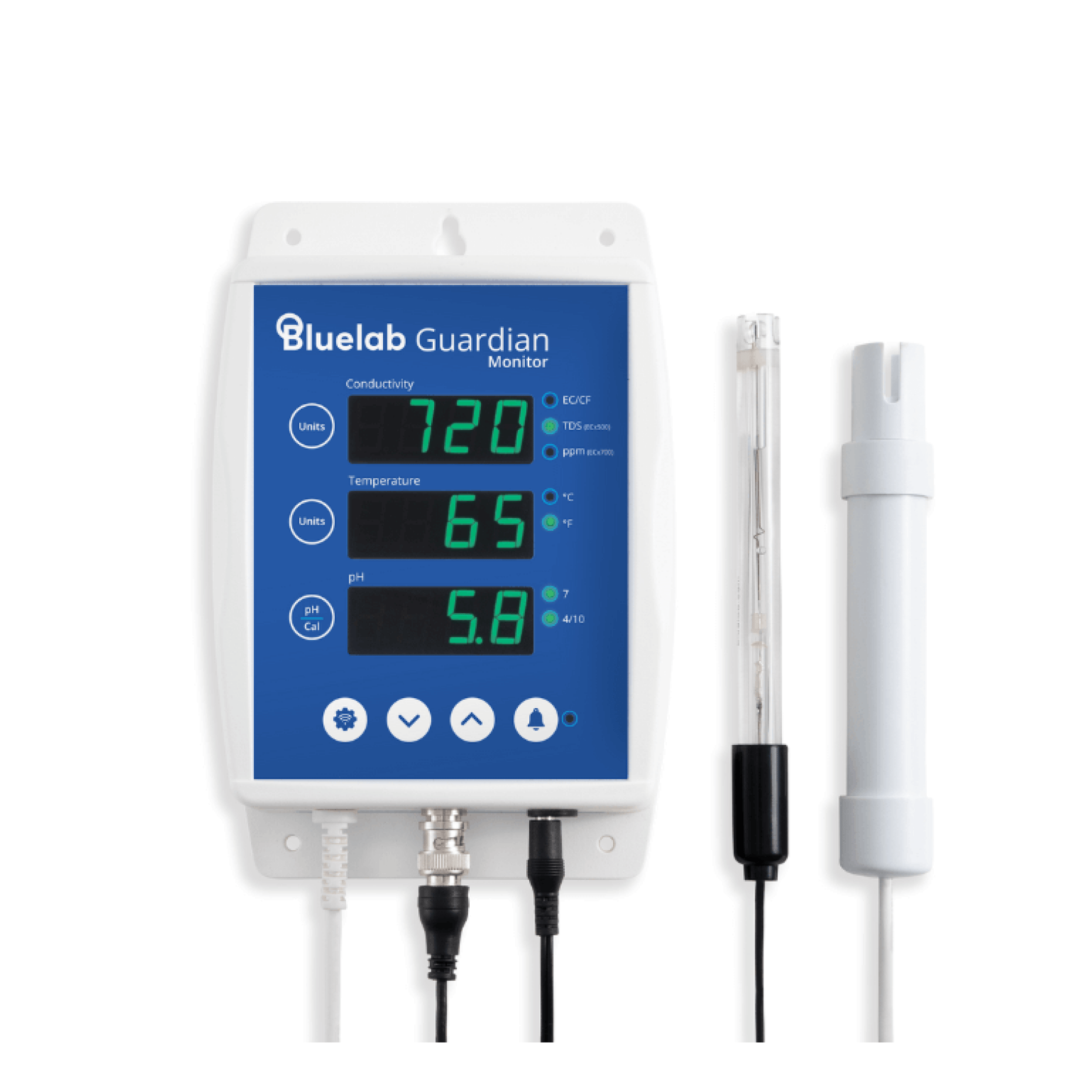
What does the Bluelab Guardian WiFi Monitor do?
It continuously monitors pH, EC/ppm, and temperature in your reservoir, displaying real-time values 24/7. It’s a monitor, not a controller—it won’t dose, but it helps you stay in control of your nutrient environment at all times.
How does it compare to a handheld meter?
Unlike handheld meters, the Guardian WiFi Monitor provides constant, always-on monitoring. You don’t need to take repeated spot checks—it keeps you updated at a glance or remotely through WiFi.
What nutrient scales can I view?
You can view EC, CF, ppm 500, or ppm 700, depending on your settings. EC is the most universal reading for comparing nutrient strength across brands and feeding charts.
Does it show temperature in °C and °F?
Yes—you can choose between Celsius and Fahrenheit. It also includes automatic temperature compensation to keep your pH and EC readings consistent when reservoir temperatures fluctuate.
How does WiFi work with the Guardian Monitor?
WiFi allows the monitor to connect to Bluelab’s Edenic app for remote viewing, alerts, and data logging. Monitoring works without internet, but WiFi adds remote features. It requires a 2.4GHz network during setup.
Can I use the Guardian Monitor without WiFi?
Yes—WiFi is optional. The monitor still displays readings locally and keeps working even if offline. WiFi can also be turned off entirely for local-only use.
Does it have alerts or alarms?
Yes—you can set high and low alarms for pH, EC, and temperature. Alarms appear on-screen and, if WiFi is enabled, can trigger push notifications via the Edenic app.
How is the Guardian Monitor powered and mounted?
It’s mains powered for 24/7 operation and includes mounting options for walls or posts. Avoid splash zones or areas with heavy mist or nutrient buildup to extend the life of the unit.
Where should I place the probes?
Place all probes in a well-mixed zone of the reservoir, away from dosing outlets or air stones. This ensures accurate, stable readings without interference from bubbles or concentrated solution “hot spots.”
Do I need to calibrate and clean it regularly?
Yes—pH probes should be calibrated every 2–4 weeks (or sooner if readings seem off). EC probes require less frequent calibration. Clean probes regularly to prevent salt or biofilm buildup.
How do I store and replace the probes?
Store the pH probe in proper storage solution when not in use. If it dries out, rehydrate and recalibrate. Probes are replaceable; swap them out when calibration fails or readings become unstable despite cleaning.
Is the Guardian Monitor compatible with different grow setups?
Yes—it’s great for hydroponics, coco, and nutrient reservoirs in soil grows. It works with organic solutions but may require more frequent cleaning. It’s not a salinity meter and isn’t ideal as a standalone tool for aquariums.
Can I install it in an inline system?
Standard models are designed for reservoir use, but accessories like sample tubes or inline setups may be available. Probes need full submersion in solution to work properly.
Why are my readings incorrect or unstable?
Check probe placement, cleanliness, and calibration. Common issues include bubbles on probes, salt buildup, poor circulation, or measuring too close to a dosing point. Always calibrate with fresh solutions.
Can I treat this as a “set and forget” system?
Mostly—but only if you stay on top of cleaning, calibrating, and proper probe storage. The Guardian Monitor delivers reliable automation, but it still depends on basic maintenance to stay accurate.