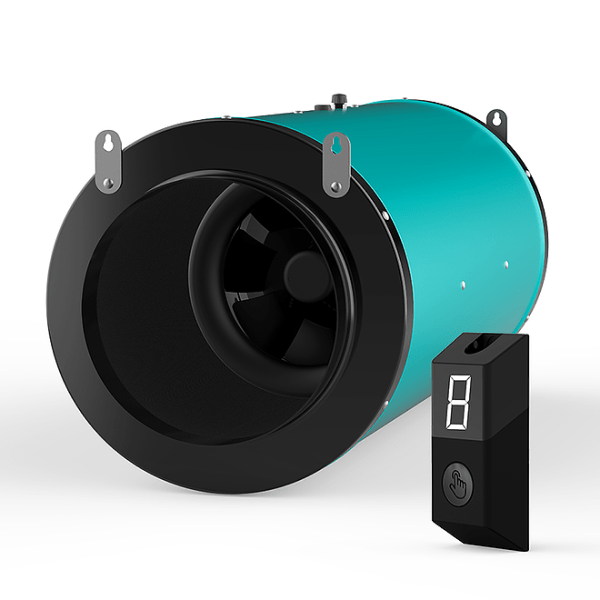
What is the Sigilventus EC Silenced Fan and how is it different?
Sigilventus EC Silenced Fan is a steel-bodied, acoustically insulated inline fan built for high airflow with low noise. It uses an EC motor for smoother speed control, less vibration, and better energy efficiency than typical AC fans—ideal for grow tents, stealth setups, or any space where noise matters.
What sizes are available and how much airflow do they deliver?
Sigilventus EC Silenced Fans come in 150mm (350 CFM), 200mm (710 CFM), and 250mm (1065 CFM) sizes. Choose based on your space volume, ducting length, and carbon filter use—larger fans can run slower for the same airflow, often reducing noise.
How quiet is the Sigilventus EC Silenced Fan really?
At full speed, it ranges from 50–55 dBA depending on size. Real-world noise is often lower, especially when paired with good ducting and run below max. Its silenced body and spring-mounted motor reduce vibration and turbulence significantly compared to standard inline fans.
Does it include mounting hardware and can it be installed in any direction?
Yes — it comes with four hanging brackets for proper vibration isolation. You can mount it horizontally or vertically, just ensure secure mounting and avoid stressing the duct connections.
What kind of speed controllers can I use with this fan?
Sigilventus EC Silenced Fan supports 0–10V, PWM, and potentiometer (POT) control. It’s compatible with most EC knob or smart controllers that output the correct signal. Do not use AC dimmers — they are not safe for EC fans.
Does the fan come with a speed controller?
No, the controller is sold separately unless specified in a bundle. Choose a compatible 0–10V or PWM controller depending on your automation goals.
Will this fan help with temperature, humidity, or odour control?
Yes — strong, quiet extraction helps regulate heat, reduce humidity if outside air is drier, and maintain negative pressure for odour control when paired with a carbon filter.
Is it compatible with carbon filters?
Absolutely. Carbon filters are a common pairing, but they add airflow resistance. You may need to run at higher speeds, and airflow will be lower than free-air ratings. Proper ducting helps maintain performance and reduce noise.
Why does airflow feel weaker than expected?
Check for clogged filters, crushed or undersized ducting, sharp bends, poor intake airflow, or low fan speed settings. Reducing duct size also adds resistance and noise — avoid if possible.
How do I reduce noise even more?
Use vibration-isolated hanging, smooth ducting, sealed joints, and minimize sharp bends. Running a larger fan at lower speeds is usually quieter than pushing a small fan hard. Acoustic ducting also helps.
Can it be used in high-humidity or grow tent environments?
Yes — it’s built for humid grow spaces and rated IPX4 (splash-resistant). Just avoid placing it where water could drip onto the electrical connections.
Is it safe for continuous 24/7 use?
Yes — it’s designed for continuous operation. Many growers run it at a baseline speed 24/7 to maintain stable conditions and only ramp up when temperatures rise.
What’s the best way to control this fan automatically?
Pair it with a compatible thermostat or smart controller that outputs 0–10V or PWM. This allows the fan to ramp up/down based on temperature, ideal for set-and-forget automation.
How do I clean and maintain the fan?
Unplug the fan before cleaning. Wipe dust from the housing and check the impeller area. Clean or replace filters regularly to reduce buildup. Inspect monthly or sooner if airflow drops or noise increases.
What’s the most common mistake when setting this fan up?
Using the wrong type of speed controller. EC fans need EC-compatible controls (like 0–10V or PWM). AC dimmers won’t work and can damage the fan or cause loud buzzing.