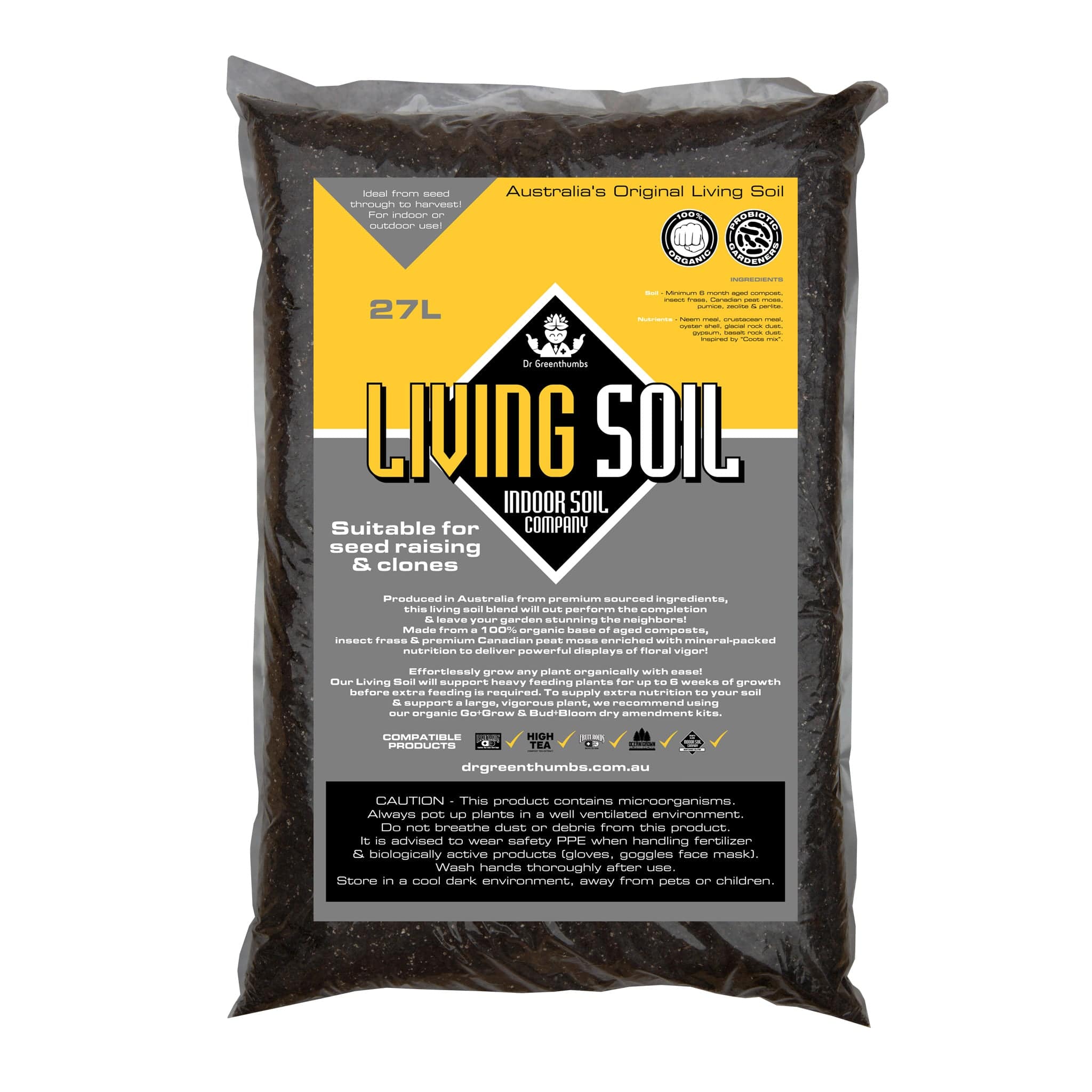
What exactly is Living Soil?
A pre-mixed, microbe-rich growing medium built off the classic Clackamas Coots recipe. Ours combines peat moss, compost, insect frass, perlite, zeolite and pumice, then mineralised with neem seed meal, crustacean meal, oyster shell, gypsum, basalt and glacial rock dust. It’s designed to grow healthy plants by letting microbes do the feeding.
For a side-by-side look at the two approaches, see our guide to super soil vs living soil.
Is Living Soil ready to use straight out of the bag?
Yep. Fill your pot/bed, water in well, and plant. No “cooking” required for our blend.
Do I need to add nutrients?
Not at the start. The mix is balanced to carry plants for a solid veg period. For longer cycles or heavy feeders, top-dress later (see “When should I top-dress?”).
What size is the bag and how much does it weigh?
27 litres per bag. Weight varies with moisture content; expect ~10–14 kg per bag.
What pots or beds is Living Soil best for?
Fabric pots, plastic pots, raised beds, and SIPs/earthboxes all work. Bigger volumes (25–50+ L per plant) keep moisture and biology more stable.
How much Living Soil do I need for my pots/bed?
As a rough guide:
• 20 cm pot ≈ 6–7 L
• 30 cm pot ≈ 14–16 L
• 40 cm pot ≈ 28–32 L
Use the volume calculator on the product page for exact numbers.
What’s the ideal pH? Do I have to pH my water?
The soil self-buffers via oyster shell and gypsum. Most growers don’t pH when using plain water. If your tap water is extreme (very hard/very soft), aim for 6.2–7.2 going in.
How should I water living soil?
Keep it consistently moist, never sodden. Fully saturate at transplant, then water when the top 2–3 cm just starts to lighten. Bottom-watering systems and/or mulch help massively.
Can I use synthetic bottled nutrients with Living Soil?
You can, but you’ll fight the biology and risk salt buildup. If you need to boost, use gentle organic top-dress or teas.
When should I top-dress?
For crops running longer than ~4–5 weeks, top-dress every 3–4 weeks: a small mix of quality worm castings/compost plus balanced dry amendments. Observe leaves; feed the soil before plants show hunger.
What dry amendments pair well with the Living Soil mix?
Stick with balanced organics: kelp, neem/karanja, crustacean meal, and a mineral mix (basalt/gypsum/oyster). Go light and consistent rather than heavy and sporadic.
Is Living Soil okay for seedlings and clones?
Yes—plant cuts/seedlings directly, but don’t overwater. If you’re nervous with very tiny starts, use a small plug or a lighter seed-start mix and transplant after roots set.
Indoor or outdoor?
Both. Indoors you’ll appreciate the structure and water-holding; outdoors it thrives in beds and large containers.
Does Living Soil contain coco coir?
No. The base is peat + compost + aeration.
What’s the role of insect frass and crustacean meal here?
They add chitin and slow-release nutrition that stimulate plant immune responses and microbial activity—tougher, more resilient growth.
Is Living Soil certified organic?
Ingredients are natural/mineral, but the finished mix itself isn’t 3rd-party certified. It aligns with organic growing practices.
Any allergen considerations?
Yes—crustacean meal and oyster shell are present. Avoid skin contact or dust inhalation if you have shellfish sensitivities.
Will I get fungus gnats or pests from living soil?
Any rich potting mix can attract gnats if kept wet on the surface. Prevent with: proper watering, top mulch, yellow traps, and BTi drenches if needed.
Should I mulch the surface?
Highly recommended. Straw, leaf mold, or cocoa husk chips reduce evaporation, buffer temps, feed microbes and cut gnat pressure.
Do I need mycorrhizae inoculants?
Optional. The composted base is biologically active; adding myco at transplant can help root contact, especially in sterile environments.
Can I reuse Living Soil?
Absolutely. After harvest, cut stems at the base, pull old roots if you like, top-dress with compost + minerals, re-wet, and replant. Living soil improves with each cycle if you feed the soil.
How many runs before I should “refresh” it?
With consistent top-dressing and good watering, many growers run the same soil multiple cycles. If structure compacts after many runs, blend in fresh aeration and compost.
Can I mix Living Soil with my old potting mix?
Yes, but aim to keep at least 50–70% Living Soil for the biology and mineral balance to shine. Add extra aeration if your old mix is heavy.
What about SIPs/earthboxes and auto-watering?
Works well—just avoid keeping the entire profile waterlogged. Let the top 2–3 cm dry slightly between fill-ups and keep a mulch layer.
EC/PPM targets?
Not how living soil is managed. Focus on plant observation, moisture, leaf colour, and periodic gentle re-amendments.
Light/feeding intensity—can Living Soil keep up?
Yes, within reason. If you’re blasting high PPFD and pushing CO₂, plan small, regular top-dresses and maybe supplemental teas to match demand.
Transplant schedule tips?
Start in a small pot (0.5–1 L), then step up to 3–5 L, then into your final container. Water fully only after each transplant to settle soil around roots.
Does Living Soil contain lime?
Buffering comes from oyster shell (calcium carbonate) and gypsum (calcium sulfate) instead of generic garden lime.
What if my tap water is very hard (>250 ppm)?
Consider filtering (carbon/RO blend) or collect rainwater. Hard water can gradually push pH up and add salts that slow microbes.
Can I brew compost teas with Living Soil?
You can use simple, aerated compost/ewc teas or botanical teas (kelp/aloe), but don’t overdo it. Consistent top-dressing + good moisture is 90% of success.
Will Living Soil burn my plants?
Not when used as directed. It’s balanced and microbe-mediated—far gentler than hot “super soil” style mixes.
How long can I store unopened bags?
6–12 months in a cool, dry place out of sun. Expect some moisture variation; fluff before use.
How do I rejuvenate a bag that’s compacted in storage?
Open, break up clumps by hand, and moisten evenly before planting. Add a handful of extra aeration if the structure feels tight.
Is Living Soil safe for food crops and herbs?
Yes—these are natural inputs commonly used in organic market gardening.
Can I blend biochar into Living Soil?
Sure—pre-charge biochar with compost/ewc and mix in at 5–10% if you want extra CEC and moisture buffering.
Any signs I’m over-watering?
Droop + soggy top layer + slow growth. Correct by improving aeration, letting the top dry slightly, and adding mulch rather than more water.
Any signs I need to feed the soil?
Pale new growth, slowed vigour mid-cycle, or early fade. Top-dress light, water in, and give it a week—biology needs time.
What temp range does living soil prefer?
Root zone around 18–24 °C. Keep pots off cold floors in winter; in summer, mulch and avoid direct pot heating.
Does Living Soil smell?
It should smell like fresh earth. Sour or rotten smells = too wet and anaerobic—let it breathe, add aeration, and back off watering.
What if I see white fuzz on the mulch?
That’s saprophytic fungi—good guys decomposing organic matter. Leave it be; it’s a sign of life.
Can I use foliar sprays with this system?
Yes—kelp, silica, or IPM-friendly sprays are fine. Avoid harsh salt foliar feeds that can stress leaves and microbes.
Shipping, pickup & returns?
Ships Australia-wide; Click & Collect available from Bellambi, NSW. Standard shop policies for shipping/returns apply.
Who is this mix best for?
Growers who want rich flavour, resilience, and reuse. If you like feeding bottles daily, this probably isn’t your jam. If you want the soil to do the heavy lifting, you’re home.